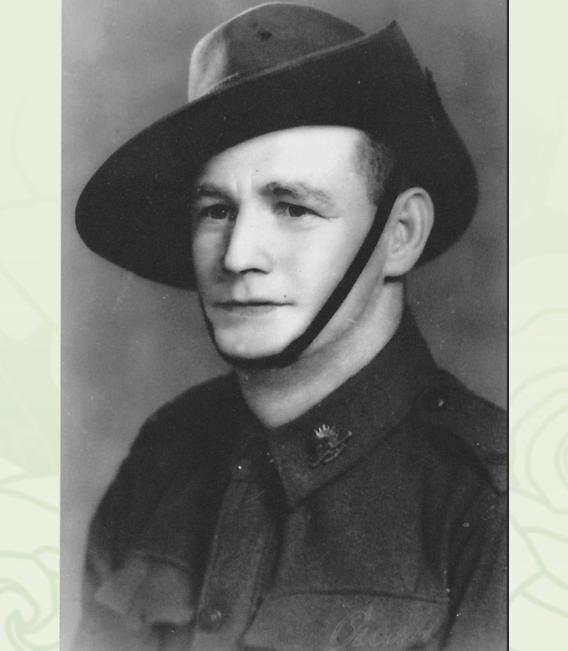
Lance Corporal
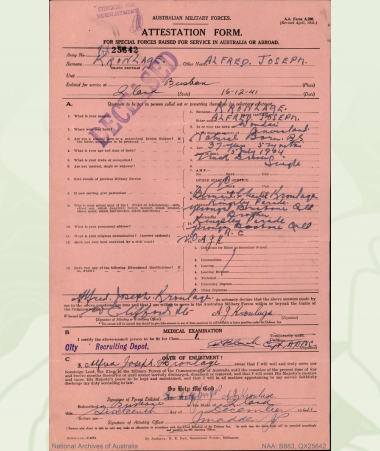
Alfred Joseph Kronlage

Alfred Kronlage was born on the 11th of June 1940 in Wondai, Queensland, to Mr Franz (Frank) Anton Kronlage and Mrs Jessie Edith Kronlage (nee Ide) as the fourth of their 5 children.
| Service Number: | QX25642 |
| Place of Enlistment: | Brisbane |
| Age of Enlistment: | 37 Years 5 Months |
| Date Of Enlistment: | 6th December 1941 |
| Embarked: | Townsville, 18th of January 1944 |
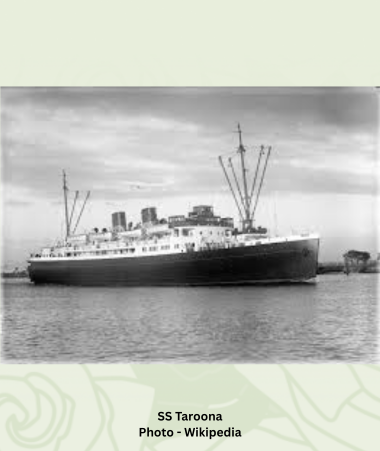
| Transport Ship: | SS Taroona |
| Medals: | 1939-45 Star, Pacific Star, War Medal, Australian Service Medal |
| Place of Death: | Killed in Action, Torricelli Mountains, Papua New Guinea, 3rd of May 1945 |
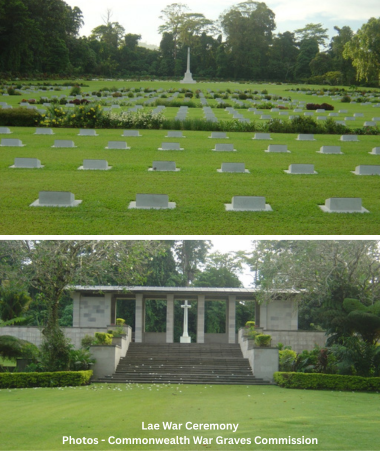
| Resting Place: | Buried Lae War Ceremony, NN. A. 7. 13, New Guinea |
| Unit: | 12th Air Maintenance Company, Australian Army Service Corps |
Additional Information:
Alfred Kronlage was born on the 11th of June 1904 in Wondai, Queensland, to Mr Franz (Frank) Anton Kronlage and Mrs Jessie Edith Kronlage (nee Ide) as the fourth of their 5 children. His older siblings were (from oldest to youngest) Francis (died in infancy), Avis and Doris; and his younger brother was Bernard. Alfred's early life was marked by tragedy with the deaths of both of his parents and his sister Avis before his 18th Birthday. His mother Jessie was reported missing in 1913 and her body was never found, his father Frank remarried in 1915 but passed away on the 17th of January 1918 and his sister Avis passed away on the 11th of June 1919. In 1932 Alfred moved to Upper Coomera, where he worked as a labourer and a truck driver. After his enlistment in 1941 Lance Corporal Kronlage served in the Australian Army Service Corps, initially as a driver and then later with the 12th Air Maintenance Company. Lance Corporal Kronlage was killed in an air crash on the 3rd May 1945 when the C47 aircraft that he was on (C47-CIG) struck a mountain while carrying out a supply drop. The cause of the crash is unknown.
Logistics and supply were a significant challenge for both sides in the Papua New Guinea campaign. This was primarily due to the adverse conditions created by the unique geography and topography of this theatre. Papua New Guinea contains extensive mountains, rivers, equatorial swamps and rainforests. In turn this meant that there was little in the way of pre-existing roads, ports and airfields to facilitate logistical operations. To address these problems the Allies increasingly turned to the then novel practice of aerial resupply for troops in the field. The aim was that a transport aircraft, usually a C47 (which was a militarised version of the widely used Dakota DC3 commercial airliners), would fly to a designated 'drop zone' at which point the crew of the aircraft would unload the cargo in midair. An attached parachute would be unfurled immediately afterwards resulting in the safe aerial delivery of the cargo to the designated drop zone (usually, results were variable with this novel practice). It is this duty that Lance Corporal Kronlage was undertaking when he was killed in action. This role still exists in the Australian Defence Force where it is performed by specialists called Loadmasters from the Royal Australian Airforce.
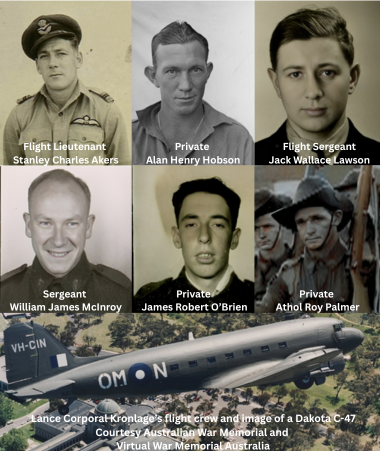
On 3 May 1945, No. 36 Squadron Dakota C47-CIG failed to return from a supply drop mission and crashed in the Housicep – Tadji area at about 0800 hours that morning. Army patrols were initially unable to locate the aircraft and rescue efforts had to be abandoned. However, the wreck was later located and the remains of the crew recovered.
On board were:
Flight Lieutenant Stanley Charles Akers (400767) (Pilot)
Private Alan Henry Hobson (QX18471) (12 Air Maintenance Platoon AASC)
Lance Corporal Alfred Joseph Kronlage (QX25642) (12 Air Maintenance Platoon AASC)
Flight Sergeant Jack Wallace Lawson (433924) (Second Pilot)
Sergeant William James McInroy (449069) (Navigator)
Private James Robert O’Brien (VX125472) (12 Air Maintenance Platoon AASC)
Private Athol Roy Palmer (NX154450) (12 Air Maintenance Platoon AASC)
Lae War Cemetery - Video Dynamic Sky Veiws
Medals & Awards
.png)
The 1939–45 Star is a campaign medal awarded to Australians who had served between 3 September 1939 and 2 September 1945 for a minimum of 6 months, or two months for air crew personnel.
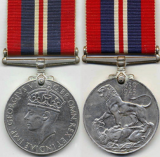
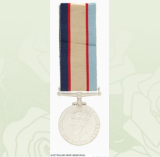
The War Medal 1939-45 was awarded for 28 days full time service in the armed forces over the duration of the Second Word War.
Civilians who worked with the armed services as well as those who served in military hospitals also received this medal.
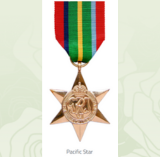
The Pacific Star was awarded for operational service in the Pacific Theatre of Operations between 8 December 1941 and 2 September 1945.
The Australia Service Medal 1939-45 was instituted in 1949 to recognise the service of members of the Australian Armed Forces and the Australian Mercantile Marine during World War II.
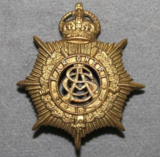
Badge of the Australian Army Service Corps
%20Aircraft%20Loading%20(1).png)
1 - Australian War Memorial
2 - Theodore Electorate Office
3 - Virtual War Memorial Australia
4 - Australian National Archives
5 - Wikipedia
6 - YouTube
7 - Births, Deaths, Marriages Queensland
8 - Department of Defence
.png)