
Private
Edward William Bourke

Private Edward William Bourke served with the 15th Australian Infantry Battalion. Formed in 1914 as part of the all-volunteer Australian Imperial Force from Queensland and Tasmanian recruits, the battalion fought during the Gallipoli Campaign and on the Western Front during the First World War
| Service Number: | 110 |
| Place of Enlistment: | Enoggera |
| Age of Enlistment: | 23 Years |
| Date Of Enlistment: | 14th October 1914 |
| Embarked: | Melbourne 22nd December 1914 |
| Transport Ship: | A10 HMAT Ceramic |
| Medals: | 1914/15 Star, British War Medal, Victory Medal |
| Place of Death: | Wounded in action, Gallipoli, 29th May 1915 |
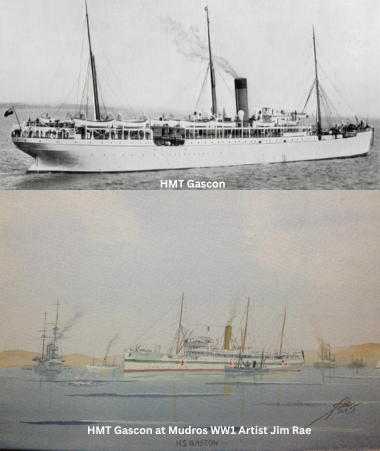
| Died of wounds on board HMT Gascon off Dardanelles | |
| 30th May 1915 | |
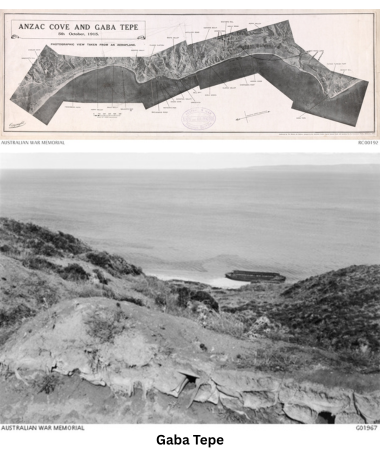
| Resting Place: | Buried at Sea 3 miles off Gabe Tepe Turkey |
| Commemorated on Lone Pine Memorial Gallipoli Turkey | |
| Unit: | 15th Australian Infantry Battalion AIF |
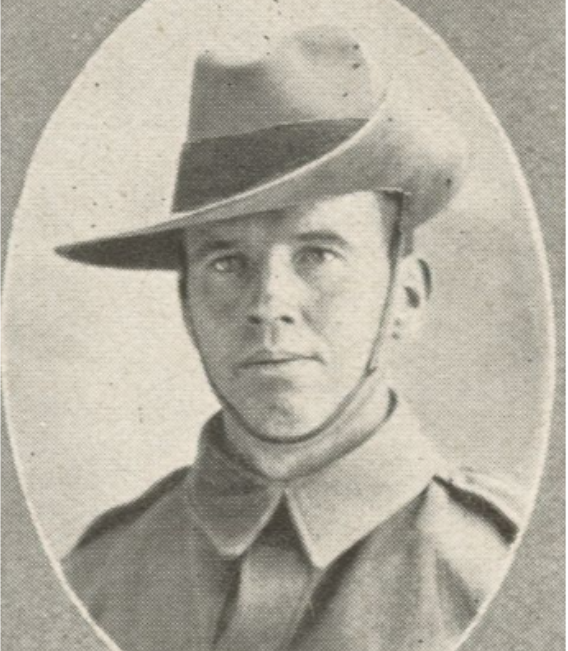
Private Edward William Bourke served with the 15th Australian Infantry Battalion. Formed in 1914 from Queensland and Tasmanian recruits as part of the all-volunteer Australian Imperial Force. The Battalion fought during the Gallipoli Campaign and on the Western Front during the First World War.
On the 29th of May 1915, the 15th Battalion was ordered to conduct a counterattack at Quinn’s Post against the Turks, who had attacked and occupied some of the Australian trenches after detonating a mine under them. After fierce fighting the 15th Battalion was successful at retaking Quinn’s Post from the Turks, with both sides taking heavy casualties. Private Bourke suffered a gunshot wound during this battle which led to his death the next day onboard the hospital ship HMT Gascon. He was buried at sea.
Private Bourke is something of an enigma (and probably a testament to the difficulty of historical record keeping).
Eagle eyed observers will note that his name does not in fact appear on the Upper Coomera Cenotaph, rather a soldier called Pte C Bourne is listed. There are two soldiers under the name of C Bourne who died in the First World War, neither of whom are from Queensland nor have any connection with the Northern Gold Coast. There are two fallen Bourne’s who have middle names beginning with C, but the aforementioned problems are still present. The closest fallen soldier that can be found under this name is Private Oliver Gabriel Bourne (the letters G and C on the Cenotaph are very similar) who was born in NSW but enlisted in Brisbane. However, there are again no records linking him to the Northern Gold Coast.
Mr Ken Golden of the Northern Gold Coast RSL sub-branch suggested to me that this name has been incorrectly engraved and that the correct name should be Private Edward William Bourke and I find this convincing. Firstly, Pte Bourke was born in Coomera, so he has a clear connection to the local area. Like Pte Bourne, Pte Bourke was in the 15th Australian Infantry Battalion, which would heighten the chance of a mistake if the name was taken from an alphabetically arranged list.
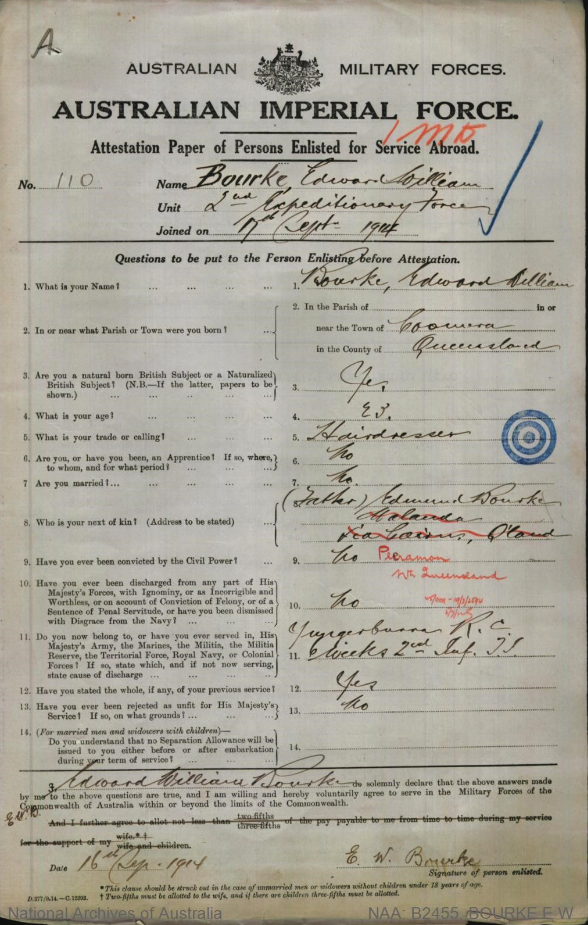
However, a closer examination of Pte Bourke and the historical records held in the National Archives reveals some striking anomalies. The most notable of these are three separate enlistment/attestation forms for a Pte Edward Bourke, on three separate dates using three different service numbers (1782, 3702 and 110). All of these appear to be for the same person. Two of these can be simplified immediately as The Army Records Department and National Archives consider service numbers 3702 and 1782 as separate enlistments for different forces but belonging to the same person. I believe this to be accurate so we will say that there are two Pte Edward Bourke’s listed.
Both list the same next of kin as Edward Bourke living in Malanda QLD (southwest of Cairns). Both record him as a Roman Catholic. Both list his occupation as a hairdresser. The medical examinations on all three enlistment forms describe a man of the same height, age, complexion, chest measurements, hair colour, eye colour and roughly the same weight. Crucially, one of these sets of records (service number 110) shows Pte Bourke dying at Gallipoli while the other one (Service number 3702) shows Pte Bourke surviving the war (albeit missing his right arm above the elbow). Naturally this is something of a conundrum.
The surviving Bourke first enlists in Townsville on the 14th of August 1914. This is an enlistment with the Australian Naval and Military Expeditionary Force (AN&MEF) to participate in the expedition to capture German New Guinea and Germany’s southern Pacific possessions (Service Number: 1782). This is a separate force to the AIF and Pte Bourke was discharged from this special force on the 18th of September 1914 in Townsville. He did not serve in New Guinea as he was discharged “on account of the trouble caused by the firemen on troopship”, which essentially means that the troops from Townsville could not be transported to the warzone due to strike action by ship crews. At any rate his services were not immediately required by the Crown.
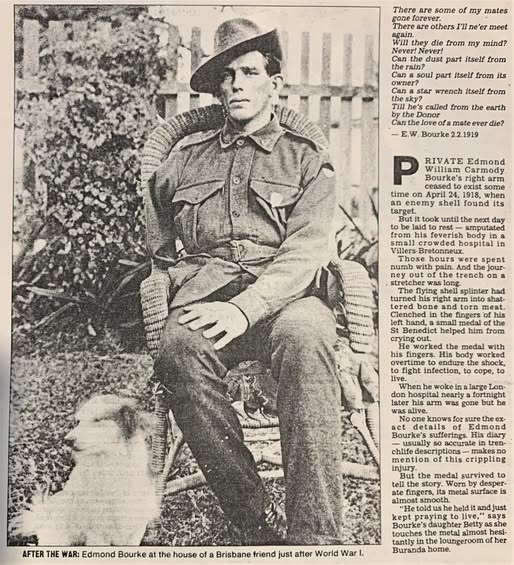
He subsequently re-enlisted/ transferred to the AIF on the 27th of September 1915 (service number 3702) which is after the recorded date of death for Pte Bourke (service number 110) at Gallipoli. This led to an extensive service record on the Western front with the 49th Battalion serving mainly as a signalman. He fought in and was successively wounded in several battles and was awarded the Military Medal for his conduct at Pozieres. He also had multiple hospital stays for various illnesses. On the 24th of April 1918 he was Wounded in Action, resulting in the amputation of his right arm above the elbow. He was subsequently discharged and survived the war, returning to Australia.
After returning to Australia, Pte Burke was married with multiple children and died June 1979. He has been featured in several commemorative newspaper articles which reveal him to be an enthusiastic amateur poet. These articles also make it clear that while his preferred name was Edward, His full name is Edmond William Carmody Bourke, which is confirmed by Births Deaths and Marriage’s Queensland (13-06-1891).
The second enlistment (service number 110) is recorded as dying at Gallipoli. The only additional thing to note for him is that there appears to be pages missing from his service and casualty form held by the National Archives. In particular, these seem to relate to his service before his death. The dates between the two enlistments and distance involved would strongly suggest that this Bourke is a different Bourke to the one who enlisted in the AN&MEF. Indeed, there are no corresponding birth records for an Edward William Bourke in Births Deaths and Marriage’s Queensland, although there is a corresponding record for his death.
I am honestly unsure what to make of all this. At any rate, some deception seems to be involved. It has been suggested to me that Bourke (110) is a false enlistment using Bourke (3702) details. If this is so it is a remarkable (borderline fantastical) coincidence as the Bourke who fell at Gallipoli was clearly a striking physical resemblance to the one who survived the war as their medical examinations are virtually identical. Additionally, the nominated next of kin (clearly the same person for both men) seems to have been willing to accept the personal effects of the deceased. Another theory is that of identical or (near enough) twins. This is an elegant theory and one that neatly resolves most of the paradoxes that at have emerged. The main problem with this theory is that I cannot find any primary source evidence that this person exists, which as far as problems go is not a trivial one.
One thing we can say for certain is that both men served their country with the utmost distinction, paying for their service with death and grievous wounds.
Medals & Awards
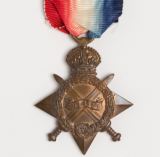
The 1914–15 Star is a campaign medal of the British Empire which was awarded to all who served in the British and Imperial forces in any theatre of the First World War against the Central European Powers during 1914 and 1915.
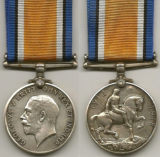
The War Medal is a campaign medal of the British Empire which was awarded to the officers and men of British and Imperial forces for their service in the First World War.
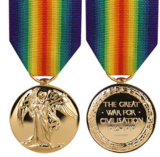
The Victory Medal was awarded to all those who served in the armed forces during the First World War. Civilians who worked with the armed services as well as those who served in military hospitals also received this medal.
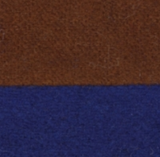
15th Australian Infantry Battalion Unit Patch was a horizontally aligned, rectangular wool flannel colour patch, divided brown over dark blue. It was worn as a distinguishing unit indicator at the head of each sleeve from early 1915.
.png)
.png)