Private
James William Bozier Barr

James William Bozier Barr was born on the 23rd of August 1891 in Coomera Queensland, to Mr James Frank Barr and Mrs Mary Jane Barr (nee Bozier) as the youngest of their nine children. His older siblings (from eldest to youngest) were Arthur, William, Eva, Sarah, Lucy, Bertha, Charles and Maurice.
Service Number: | 3115 |
Place of Enlistment: | Brisbane, Australia |
Age of Enlistment: | 25 Years, 11 Months |
Date of Enlistment: | 25th September 1916 |
Embarked: | Sydney, 22nd December 1916 |
Transport Ship: | A64 HMAT Demosthenes |
Education: | Coomera State School, Queensland |
Medals: | British War Medal, Victory Medal |
Place of Death: | Wounded in Action (Gassed), France, Villers Bretonneux 23rd of July 1918 |
Died Of Illness (Pneumonia), France 12th of February 1919 | |
Resting Place: | Buried Charleroi Communal Cemetery, Plot 1 Row B Grave 6, Belgium |
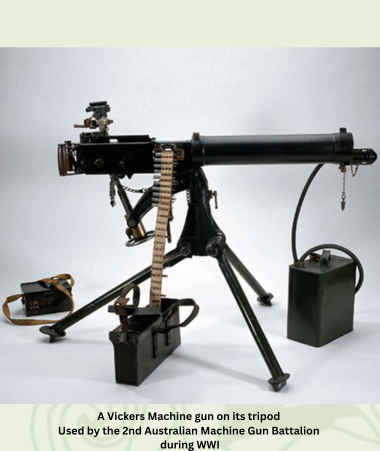
Unit: | 2nd Australian Machine Gun Battalion AIF |
.png)
James William Bozier Barr was born on the 23rd of August 1891 in Coomera Queensland, to Mr James Frank Barr and Mrs Mary Jane Barr (nee Bozier) as the youngest of their nine children. His older siblings (from eldest to youngest) were Arthur, William, Eva, Sarah, Lucy, Bertha, Charles and Maurice. James Snr and Mary married in Mudgeeraba, Queensland in 1874 and raised their family in Coomera, Queensland, where James Snr was a farmer. Before his enlistment in the A.I.F, James William Bozier Barr worked as a Motorman in Brisbane.
After his enlistment, Pte Barr was initially assigned to the 8th Reinforcements earmarked for the 49th Battalion and subsequently assigned to the 2nd Machine Gun Battalion. The 2nd Machine Gun Battalion was formed in March 1918 and consolidated the Machine Gun Companies of the three brigades within the Division; the 5th (NSW), 6th (Vic), 7th (Outer States), and the 22nd Machine Gun Company.
Pte Barr was wounded in action on the 23rd of July 1918 when the 2nd Machine Gun Battalion was subjected to a sustained bombardment of mustard gas in the Villers Bretonneux area. He was to spend the rest of his war service convalescing in hospital. Pte Barr survived the war however he never returned to Australia, dying of Bronchial Pneumonia on the 12th of February 1919. As the Spanish Flu pandemic was raging at this time it is likely that this is what caused his death. The damage that he had suffered to his respiratory system from the mustard gas would certainly have aggravated his illness.
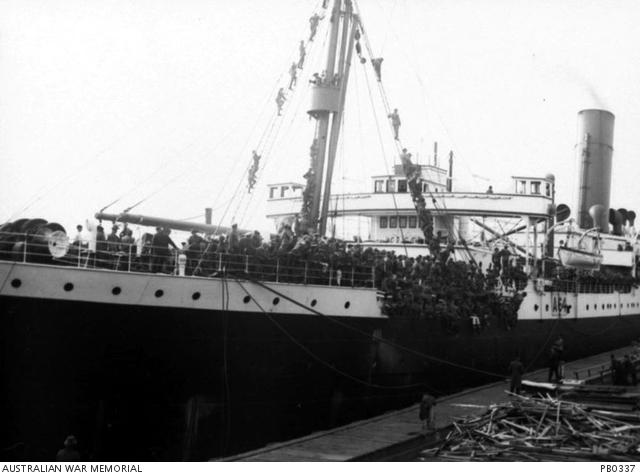
Troops on board HMAT Demosthenes (A64) prior to departure
Medals & Awards
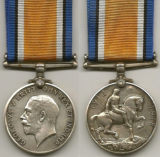
The War Medal is a campaign medal of the British Empire which was awarded to the officers and men of British and Imperial forces for their service in the First World War.
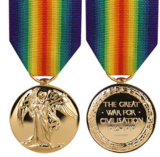
The Victory Medal was awarded to all those who served in the armed forces during the First World War. Civilians who worked with the armed services as well as those who served in military hospitals also received this medal.
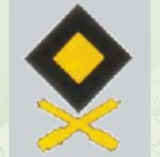
Diamond shaped colour patch for 2 Division Machine Gun Company and 22 Australian Machine Gun Company, AIF, showing a central white diamond on a black background, below which are two crossed guns in yellow.
Worn as a distinguishing unit indication at the head of each sleeve from 1917. The two crossed guns were the patch of the Machine Gun Corps, although they was not worn by machine gun squadrons allotted to the Light Horse brigades.
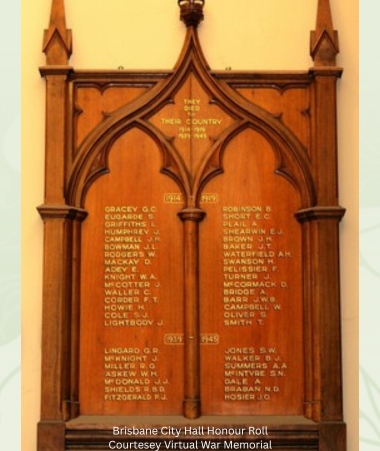
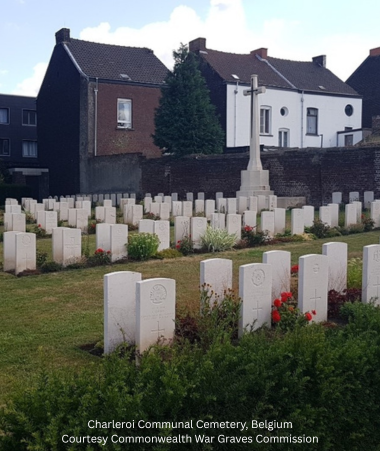
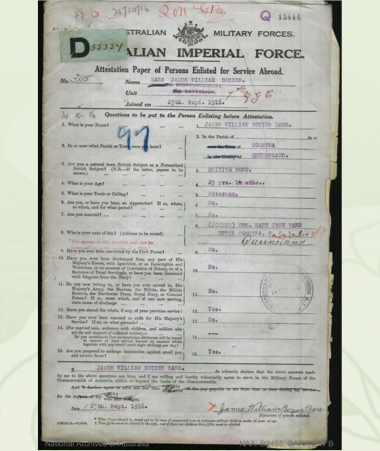
(1).png)
.png)